
How to Choose a Wedding Bouquet That Feels Like You
A wedding bouquet is one of the most personal floral elements of a wedding.
It moves with you.
It appears in portraits, accompanies you down the aisle, sits beside you during quiet moments, and often becomes one of the most photographed details of the entire celebration.
And yet, choosing a bridal bouquet often begins with a question that is almost impossible to answer:
What flowers do you want?
We prefer to begin somewhere else.
Start With How You Want the Wedding to Feel
Before selecting a flower variety, consider the atmosphere of the celebration.
Romantic or architectural?
Garden-inspired or refined?
Soft and quiet or expressive and sculptural?
Modern, editorial, timeless, organic, minimal?
These words provide considerably more creative direction than beginning with a list of flowers.
A bouquet should communicate something about the person carrying it and the environment surrounding them.
Consider the Wedding Dress
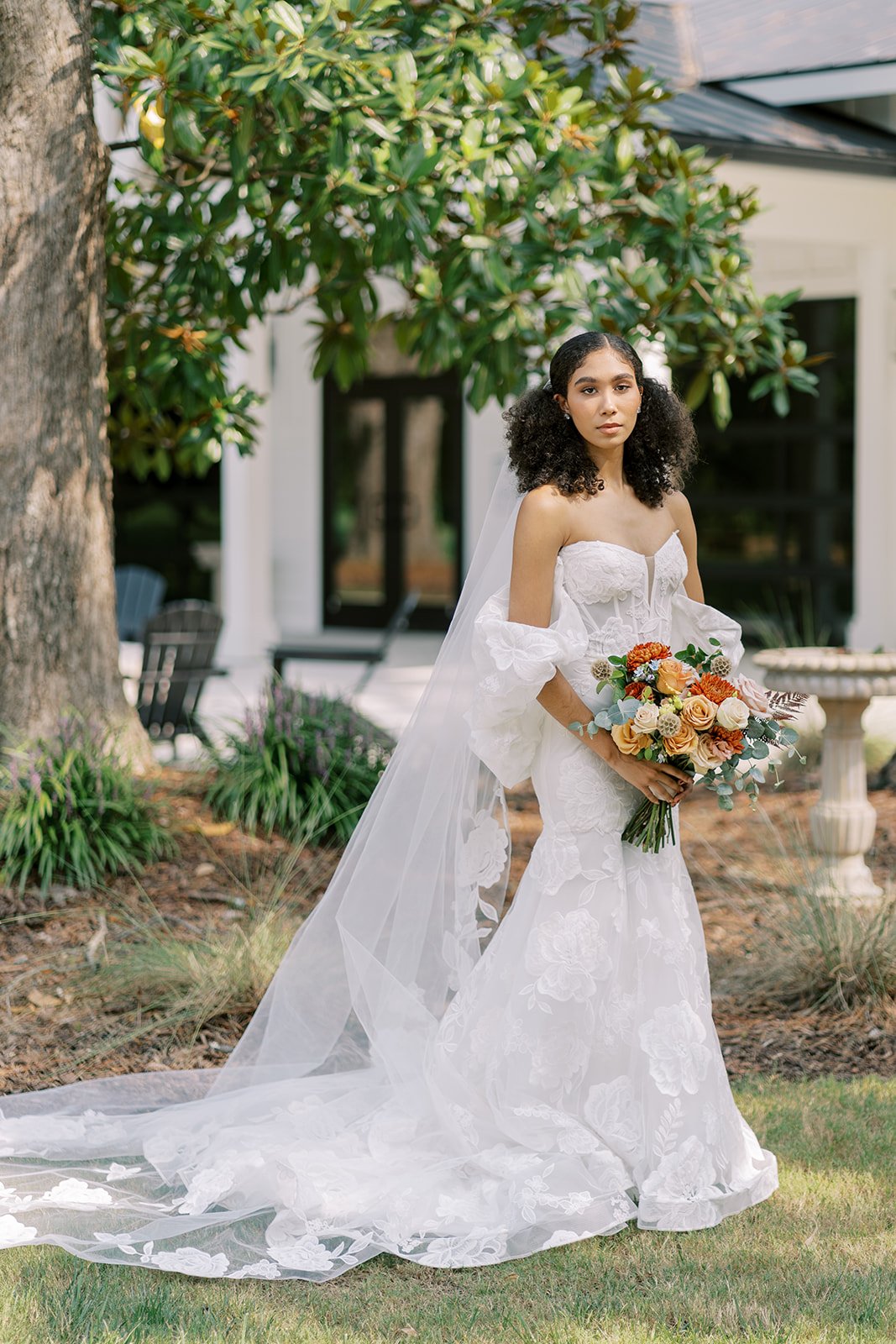
The relationship between the bouquet and the wedding dress is especially important.
A highly detailed gown may benefit from a bouquet with greater restraint.
A minimalist silhouette can create an opportunity for more botanical movement or sculptural form.
A cascading bouquet creates a very different relationship with the body than a petite hand-tied bouquet.
Proportion matters.
Shape matters.
Movement matters.
The bouquet should complement the bride rather than visually overwhelm her.
Let the Venue Influence the Flowers
Architecture also provides clues.
A formal ballroom, modern art museum, historic estate, intimate garden, contemporary venue, and destination property each establish a different visual environment.
The bridal bouquet doesn't need to match the venue literally.
But it should feel as though it belongs within the same story.
Think Beyond Color
Wedding bouquet inspiration is often organized around color palettes, but some of the most interesting bouquets are created through texture and form.
The curve of a stem.
The movement of a vine.
The translucence of a petal.
The architecture of an unusual flower.
The quiet contrast between something delicate and something structural.
These details give a bouquet dimension.
Allow the Season to Participate
Seasonal wedding flowers bring a sense of time into the celebration.
Rather than insisting upon an exact flower recipe, allowing some flexibility gives the floral designer an opportunity to select materials that are particularly beautiful during the week of the wedding.
Your inspiration still matters.
The palette still matters.
The overall floral direction still matters.
But the flowers themselves are allowed to respond to nature.
That can make a bouquet feel more alive.
Your Bouquet Does Not Need to Look Like Everyone Else's
Wedding imagery can be helpful when identifying what you love.
But inspiration should be a starting point rather than an instruction manual.
At Lavish Leaf, we are interested in understanding why an image resonates.
Perhaps it is the looseness.
The elongated shape.
The negative space.
The monochromatic palette.
The unexpected foliage.
The feeling.
Once we understand that, we can translate the idea rather than simply recreate the picture.
A Bouquet Should Feel Personal
There is no universally perfect bridal bouquet.
The right bouquet is the one that feels connected to you, your clothing, your celebration, and the environment in which the wedding takes place.
Some brides will carry something abundant and romantic.
Others may choose a quiet collection of a few extraordinary flowers.
Some will gravitate toward cascading movement.
Others toward sculptural restraint.
Luxury isn't determined by how many flowers you hold.
It is found in the thought behind every one of them.
And perhaps that is the most beautiful way to choose a wedding bouquet:
Not by asking what everyone else is carrying.
But by asking what belongs in your hands.